

















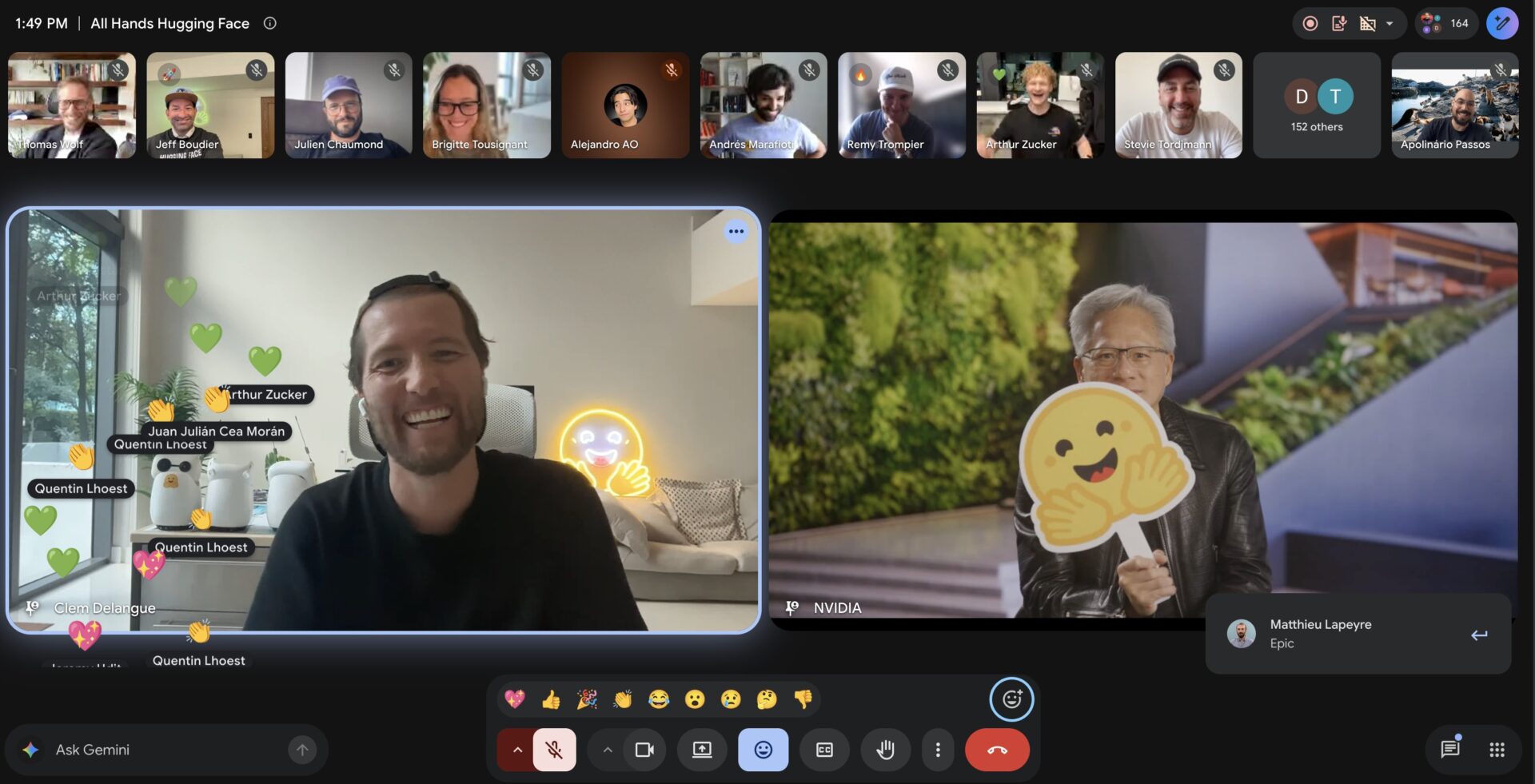
The NVIDIA Hugging Face acquisition is now official. Jensen Huang said NVIDIA agreed to buy the open-model hub for 12.93 billion dollars. Hugging Face CEO Clement Delangue said he went to Huang, and that the founders and team are staying.
What NVIDIA is paying for
Huang’s post puts more than 18 million developers, researchers, and creators on the platform. They share more than 3 million models, 500,000 datasets, and 1 million applications. In addition, more than 200,000 companies use it to discover, evaluate, customize, and deploy AI. NVIDIA already publishes there. Huang said the company is the largest contributor of open models and data, with more than 500 models and more than 250 open datasets.
NVIDIA’s Form 8-K dated September 3 splits the headline. About 11.9 billion dollars goes to Hugging Face stockholders, subject to adjustments. Meanwhile, an equity retention program of up to about 1.0 billion dollars is for employees who join NVIDIA. The companies signed on September 2.
Open, and still compute-agnostic
Huang wrote that Hugging Face will remain an open platform for the entire AI ecosystem. Developers keep choosing models, frameworks, clouds, inference services, and computing platforms. Instead, NVIDIA compute will not be required to build on or deploy through Hugging Face. The filing repeats that promise. Hugging Face would still let people upload and download models and datasets of their choosing, and still support other silicon vendors.
Delangue’s post on X said NVIDIA committed to keep the platform open, independent, and compute agnostic. He also set a goal of 100 million AI builders. That sits next to Hugging Face’s own robotics line, including the Pollen Robotics Microduck the company opened for preorder last week.
Close date and the catch
NVIDIA expects the deal to close in the first half of 2027. It still needs regulatory approvals and other customary conditions. However, the 8-K also flags a policy risk. Other parties are lobbying to restrict open-source models. Any new controls could limit models or datasets on Hugging Face. NVIDIA notes that many popular open models originated in China, then get downloaded and fine-tuned worldwide.
As a result, this is an agreement, not a closed sale. The platform stays independent until regulators and closing conditions say otherwise. Hugging Face has also been in the news for security, including an OpenAI evaluation agent that spent days inside Hugging Face before staff tied it back. Huang’s bet is still the open hub, not a closed NVIDIA-only store.